
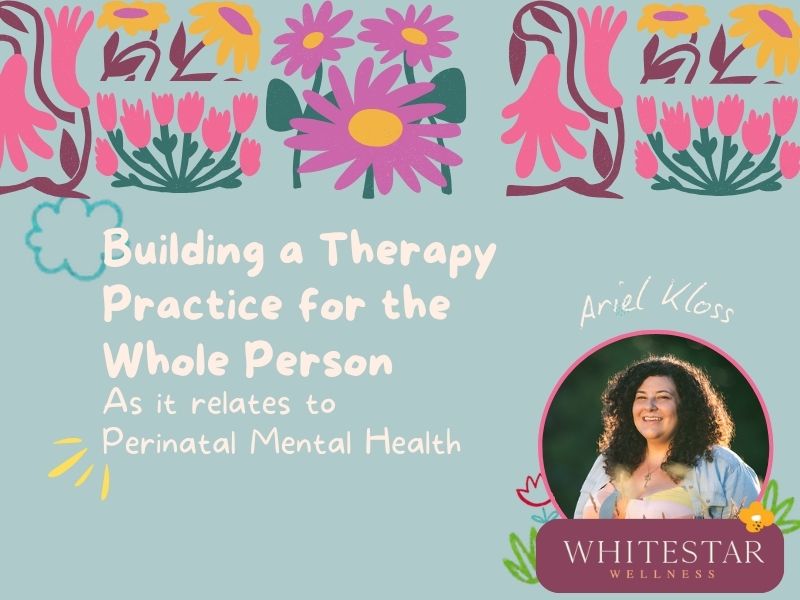
My name is Ariel Kloss and I started Whitestar Wellness, S.C. because in my 10+ years of being a social worker, I noticed that there was something lacking from a lot of traditional mental health care- the focus on connection and authenticity over labels. While diagnoses and therapy modalities serve their purposes and can help inform us in ways, I have always been passionate about making sure whoever I am in the room with feels like they are treated from a humanistic lens above all else. I wanted to create a business focused on treating the whole person and helping people to live in their most authentic form of themselves, without the labels.
Building a Practice with Intention
The Importance of Perinatal Mental Health In A Therapy Practice
Perinatal Mental Health became a focus when I personally went through my first pregnancy (I now have a 4-month-old baby boy). During this time, I realized how important it was for women to feel supported in their pregnancy and postpartum experience. Like so many others, I was only given that postpartum screening tool at all of my baby’s appointments without real, true follow-up support for my experience. I either fit into a label or not based on answering 10 questions at every pediatrician’s appointment. I knew that wasn’t enough. (I should say here that I did have some health professionals who did give me that personalized care and support I needed- namely, a nurse at my OBs office and my lactation specialist at Wisco Lactation). I wanted people to know they deserved support, even if they didn’t fit into whatever category they saw others fitting into. Prioritizing this area lets us offer care that truly acknowledges the whole person—their identity, their family context, their nervous system, their history—instead of trying to fit them into narrow diagnostic boxes.
I wanted every provider here to speak the same holistic language. Asking the entire team to train in perinatal mental health ensured that anyone seeking help would meet a provider prepared to understand the nuances, avoid oversimplifying, and support them without leaning on labels or quick fixes. It was important to me that our whole team got adequate training so that they did not fall into the same problem pitfalls we see pregnant women experience all the time. While trained in this area, all of our therapists are first and foremost trained to just treat you as a whole person- mother or not. Your experience is unique to you.
For patients, the change I hope to make is simple: I want care to feel humane. I want people to finally feel heard, understood, and treated as more than a set of symptoms. If we can offer holistic, individualized support that centers their humanity, it can shift the entire experience of getting help.
A Ripple Effect on Behavioral Health